
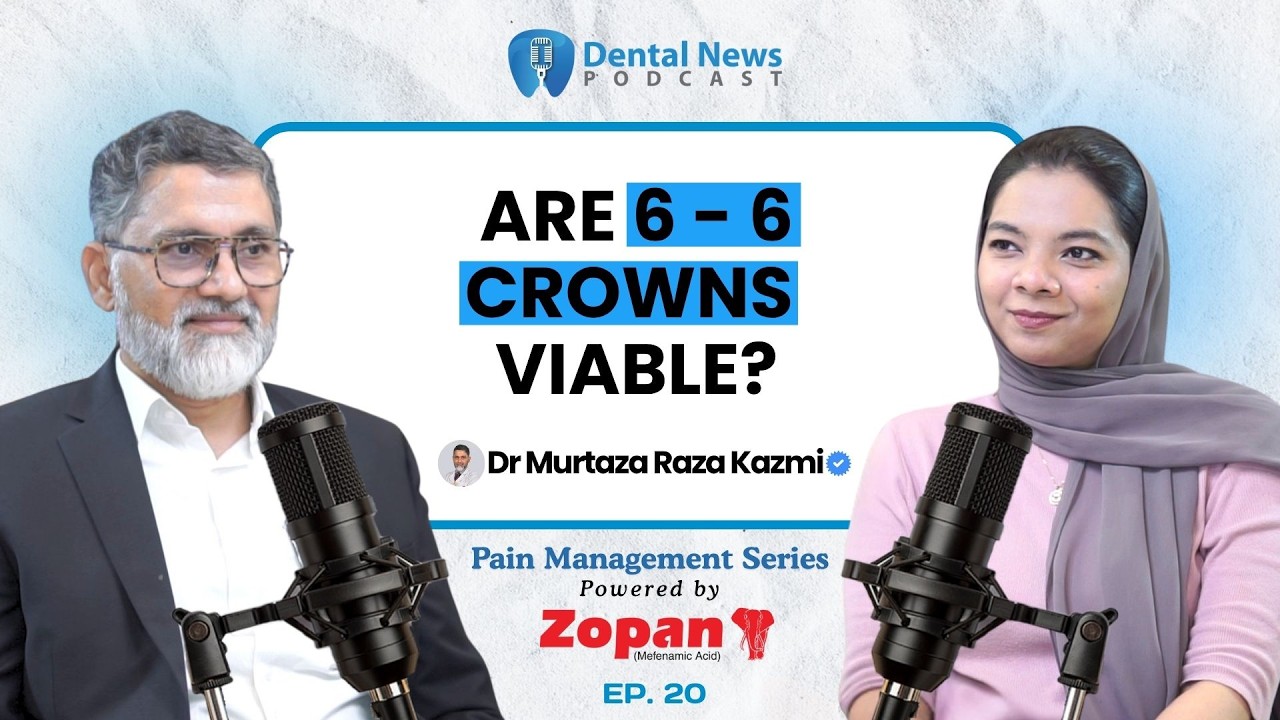
KARACHI: Patients suffering from temporomandibular disorders may undergo multiple root canal treatments, restorations and even tooth extractions before clinicians recognise that the real source of their pain is not a tooth, consultant prosthodontist Dr Murtaza Raza Kazmi has warned.
Speaking on the Dental News Podcast, Dr Murtaza said he had encountered “countless” patients who were initially treated for presumed odontogenic pain but continued to experience symptoms after repeated dental procedures.
Some had undergone root canal treatment on several teeth, while others had teeth extracted without achieving lasting relief because the underlying temporomandibular joint or muscular disorder had remained undiagnosed.
The discussion placed renewed focus on the importance of differential diagnosis, conservative care and the ethical responsibility to preserve natural tooth structure before beginning irreversible treatment.
When tooth sensitivity is not caused by a tooth
One of the difficulties in diagnosing temporomandibular disorders, commonly known as TMD, is that patients do not always present with obvious jaw-joint complaints.
Instead, they may report sensitivity, toothache or discomfort affecting several teeth. The location can shift from one side to another, and some patients may be unable to identify a single tooth responsible for the pain.
Dr Murtaza explained that, in some of these cases, the affected teeth are not the actual source of the problem. Jaw-joint overload, muscular tenderness, clenching or bruxism may produce symptoms that patients interpret as dental pain.
He said patients presenting with sensitivity without an identifiable organic cause should also be evaluated for TMD rather than being moved immediately towards invasive treatment.
Repeated treatment can deepen the diagnostic error
The patient-safety risk increases when a clinician becomes committed to an initial tooth-based diagnosis despite the patient failing to improve.
A filling may first be placed for sensitivity. If the symptoms persist without visible caries, an undetected crack may be suspected, leading to root canal treatment.
When the first treated tooth fails to resolve the pain, attention may shift to a neighbouring tooth. This can result in a cycle of additional endodontic procedures while the actual muscular or temporomandibular cause remains untreated.
Dr Murtaza said he had seen patients who received multiple root canal treatments and extractions for presumed dental pain but continued to suffer because TMD had not been properly considered.
“After two or three unnecessary root canals, we end up losing the patient,” he observed during the conversation.
He stressed the importance of examining the muscles of mastication, assessing the temporomandibular joint and identifying possible discrepancies between centric relation and maximum intercuspation before carrying out irreversible procedures in diagnostically uncertain cases.
The wider role of posture, clenching and cervical pain
The podcast also challenged the assumption that TMD is caused only by the way the teeth meet.
Dr Murtaza discussed the relationship between jaw function, head position, cervical muscles and body posture. He explained that the muscles of the neck and mastication work together to stabilise the head while the mandible moves during chewing and speech.
Poor working posture—particularly leaning towards a laptop screen with the head positioned forward and the shoulders raised—may place additional strain on the cervical muscles.
He described cervical myalgia, or muscle pain in the neck, as one factor that may contribute to a wider cycle of muscular tenderness and temporomandibular dysfunction.
Carrying a heavy laptop bag on one shoulder, persistent clenching and uneven body positioning may also disturb muscular balance, he said.
These observations underline why clinicians may need to ask about a patient’s work routine, posture, parafunctional habits and stress-related clenching rather than limiting the examination to individual teeth.
Bruxism raises risk but does not confirm TMD
Dr Murtaza cautioned against assuming that every person who grinds or clenches their teeth necessarily has a temporomandibular disorder.
Bruxism does not always lead to TMD, he explained, although it may increase the risk by overloading the teeth, muscles and joint.
Where TMD is suspected, he described habit modification, posture awareness, self-monitoring and occlusal splint therapy as important elements of conservative care.
Patients may be asked to recognise when they are clenching, modify harmful habits, follow a soft diet temporarily and improve their head and shoulder posture.
He said medication may be used during the period before a splint is delivered when clinically required, but he generally relies more heavily on splint therapy and behavioural management than repeatedly escalating pain medication.
Imaging should follow the differential diagnosis
The conversation also addressed the increasing use of advanced imaging in patients with jaw pain.
According to Dr Murtaza, investigations such as MRI and CBCT should not be ordered vaguely or as a substitute for clinical reasoning. The choice of imaging should correspond to the clinician’s differential diagnosis and the particular structure or pathology being investigated.
He said advanced radiological investigations become more useful when a temporomandibular disorder has progressed or when structural involvement is suspected.
The decision to obtain imaging—or refer a patient for an oral and maxillofacial surgical opinion—should therefore be guided by the history, examination findings and suspected diagnosis rather than being applied automatically to every patient with facial pain.
A warning against irreversible cosmetic overtreatment
Beyond TMD, the podcast moved into the ethics of restorative and cosmetic dentistry, including the growing demand for extensive smile makeovers.
Asked about placing crowns from six-to-six, Dr Murtaza distinguished between teeth that genuinely require crowns and healthy or minimally compromised teeth being prepared principally for cosmetic reasons.
Crowns may be justified where teeth have undergone extensive endodontic treatment, have insufficient remaining structure, require a ferrule for strength or form part of the rehabilitation of severely worn or mutilated dentition.
However, preparing multiple teeth purely to produce a cosmetic transformation may amount to overtreatment, he said.
His central warning was that the removal of natural tooth structure is permanent.
“Once we remove even the smallest amount of tooth structure, it is gone forever,” he said, emphasising that patients can never recover enamel and dentine removed during preparation.
He therefore urged clinicians to distinguish carefully between restorative necessity and elective intervention before recommending multiple full-coverage crowns for aesthetic purposes.
Individual crowns preferred over splinted restorations
Dr Murtaza also expressed strong opposition to routinely joining or splinting crowns placed on natural teeth.
Even where several neighbouring teeth require full-coverage restorations, he said his preference is for individual crowns rather than combining them into one connected prosthesis.
He argued that natural teeth are designed to function independently. Each tooth has physiological mobility through its periodontal ligament, which helps absorb and distribute forces during chewing and clenching.
When two teeth are rigidly joined, movement affecting one tooth may transmit altered or oblique forces to the neighbouring tooth instead of allowing both to respond independently.
He also raised concerns about hygiene and recurrent decay. Splinted crowns may change the natural interdental anatomy, reduce access for cleaning and create areas where food and plaque can accumulate around restoration margins.
According to Dr Murtaza, interdental areas are frequently where decay is later identified beneath connected crowns.
His remarks reflected a strongly stated clinical position. Restorative decisions must nevertheless be based on the circumstances of each patient, including periodontal support, tooth mobility, occlusal forces, remaining tooth structure and the reason splinting is being considered.
Tooth preservation as an ethical obligation
The discussions on TMD and cosmetic crowns were connected by one central patient-safety principle: irreversible treatment should follow a confident diagnosis and clear clinical indication.
A root canal treatment, extraction or full crown preparation cannot simply be reversed if the original diagnosis later proves incorrect.
For clinicians, this means pausing when symptoms do not correspond to objective dental findings, reconsidering the differential diagnosis when treatment fails and seeking an appropriate referral before sacrificing additional tooth structure.
For patients, it reinforces the importance of asking why a recommended procedure is needed, what alternatives exist and whether the source of pain has been conclusively established.
Persistent tooth, jaw or facial pain should be professionally assessed and should not be self-diagnosed. Symptoms may arise from dental disease, muscular disorders, joint dysfunction or other conditions that require different forms of treatment.
A podcast centred on safer and more thoughtful dentistry
The wide-ranging Dental News Podcast episode moved from professional development and medical education to research, prosthodontics, facial pain and restorative ethics.
Its most consequential message was that good dentistry is not defined by how quickly treatment begins or how many procedures are performed.
It depends on identifying the actual disease, recognising when pain may be non-odontogenic, protecting healthy tooth structure and selecting the least destructive treatment capable of meeting the patient’s genuine clinical needs.
⇒ The full conversation is available on the Dental News Pakistan YouTube channel.
Stay informed, stay ahead!
CLICK HERE TO JOIN Dental News Pakistan on WhatsApp for real-time oral health alerts, international dentistry updates, healthcare policy news and the latest developments shaping the global dental profession.
