KARACHI: Reading about periodontal surgery in a textbook can explain the principles of flap design, incision and suturing. But for young dentists learning to operate, understanding the technique is only one part of the challenge; developing the hand control, precision and confidence to perform it is another.
The Department of Periodontology at Fatima Jinnah Dental College (FJDC) recently brought that practical dimension into focus through a hands-on periodontal surgical skills workshop for house officers, led by Dr. Tahira Hyder, Head of the Department of Periodontology.
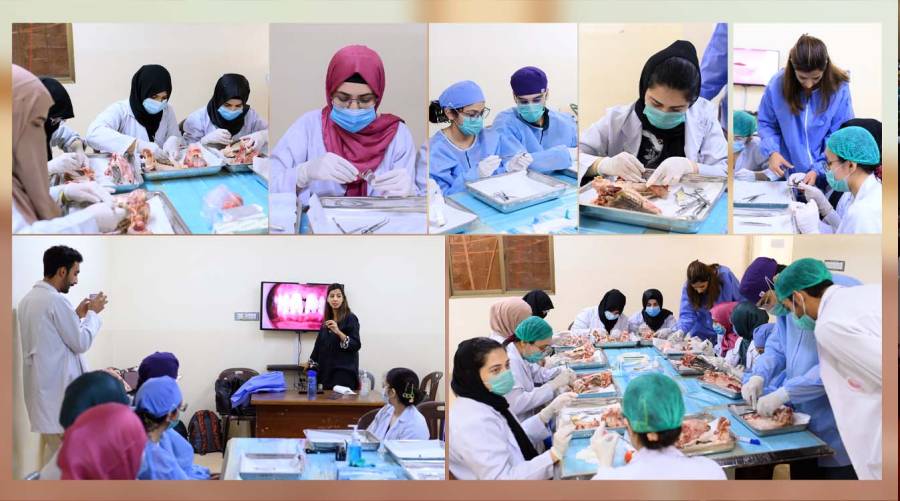
Instead of limiting the session to lectures or demonstrations, the workshop gave house officers an opportunity to repeatedly practise fundamental surgical techniques using goat heads and tomatoes as training models.
The unusual combination was intentional.
When periodontal surgery leaves the textbook
For a young dentist, making an incision is not simply about knowing where the incision should go.
Hand positioning, pressure, incision depth, tissue handling and suture tension all have to work together with precision.
The workshop was designed to give house officers an environment in which those skills could be practised before they were required in a clinical setting.
Goat heads were used because they provide a tissue environment that allows trainees to practise surgical handling, while tomatoes offered a delicate and forgiving surface on which participants could work on incision control and suturing.
The training models therefore served different purposes: one provided a more realistic tissue-handling experience, while the other allowed participants to refine delicate movements through repetition.
Incisions, flap handling and suturing
Under expert mentorship, house officers practised several fundamental components of periodontal surgery, including incisions, flap handling and suture placement.
The emphasis was not simply on completing an exercise, but on developing the controlled movements required for surgical work.
The workshop created a low-stakes environment in which mistakes could become part of the learning process rather than clinical complications.
That distinction is particularly important in procedural education.
A trainee can repeat a movement, recognize an error, adjust technique and attempt it again — gradually building the coordination that cannot be developed through reading alone.
Individual guidance at every station
The practical nature of the session also allowed participants to receive direct feedback during their exercises.
Dr. Tahira Hyder, Head of the Department of Periodontology at Fatima Jinnah Dental College, moved between the training stations, observing participants and providing individual guidance.
Her mentorship focused on details such as hand positioning and surgical technique, while drawing on her clinical experience to help house officers refine their approach.
For trainees, that one-to-one correction can turn an abstract surgical principle into something tangible: where to place the hand, how much pressure to apply and how to maintain control while working with delicate tissue.
One house officer captured that difference between theoretical and practical learning during the workshop:
“You read about flap design in books, but actually making the incision and lifting the flap teaches you things no lecture can.”
More than cutting and suturing
The workshop was not limited to surgical movements.
House officers were also exposed to the importance of tissue handling, infection control protocols and post-operative care — components that are essential to the wider process of periodontal surgical treatment.
Successful periodontal surgery involves more than technically completing an incision or placing a suture. The way tissues are handled, how infection-control principles are followed and how patients are managed after surgery all contribute to the quality and safety of clinical care.
By incorporating these elements into the practical session, the workshop connected individual surgical skills with the broader responsibilities of clinical practice.
Why repetition matters in surgical training
There is a reason procedural training cannot rely entirely on textbooks.
A written description can explain a flap design. A lecture can demonstrate a technique. But the physical execution of a surgical procedure requires coordinated movement, spatial awareness and controlled hand skills.
Those abilities develop through practice.
For the FJDC house officers participating in the workshop, repeated practice on training models provided an opportunity to develop confidence, precision and muscle memory before applying those skills in real clinical environments.
The objective was not to replace clinical supervision or patient-based learning, but to strengthen the practical foundation on which that learning can build.
A practice-based approach to dental education
The workshop reflects what Fatima Jinnah Dental College describes as a broader educational philosophy centred on practice-based, precision-driven training.
According to the supplied institutional information, FJDC has championed this approach for 35 years, with an emphasis on preparing graduates for the practical demands of modern dental practice.
At the postgraduate and house-officer training level, hands-on sessions such as this one provide an opportunity to reinforce clinical skills through repetition and supervised correction.
The underlying principle is straightforward: the more deliberately a clinician practises a technical skill, the more prepared they can be to perform it when the stakes become real.
For periodontal surgery, where precision in incision, tissue handling and suturing matters, that transition from knowing a technique to being able to perform it is particularly significant.
From practice models to clinical confidence
The goat heads and tomatoes used during the workshop may appear unconventional at first glance, but their purpose was highly practical.
They gave house officers a physical surface on which to test their technique, make adjustments and repeat movements under supervision.
That experience can help bridge a familiar gap in healthcare education: the distance between “I know how this is done” and “I can perform this correctly.”
For young dentists entering clinical practice, that difference matters.
The workshop at Fatima Jinnah Dental College placed that transition at the centre of periodontal surgical training — taking procedures that house officers may have previously encountered primarily through books, lectures and demonstrations and giving them an opportunity to develop the hands-on skills required to perform them.
Ultimately, the goal of such training is not simply to make trainees more comfortable with instruments or sutures.
It is to help them enter the clinic with greater familiarity with surgical movements, a stronger appreciation of tissue handling and a practical understanding that precision is built through repetition.
At FJDC, the message from the workshop was clear: periodontal surgery is not mastered by reading about it alone. It is learned by practising it, correcting it and practising it again.
Stay connected with Dental News Pakistan
CLICK HERE TO FOLLOW the official Dental News Pakistan WhatsApp Channel for the latest PMDC updates, dental education news, clinical innovations, research, professional events and developments affecting Pakistan's dental community.