It is difficult to pay tribute to a teacher whose influence becomes an enduring part of one's professional identity. His achievements can be recorded, his contributions acknowledged, and the milestones of his career remembered. Yet, the true measure of an exceptional teacher lies beyond these accounts—in the lives he shapes, the values he instils, and the institutions whose foundations continue to support generations long after his passing.
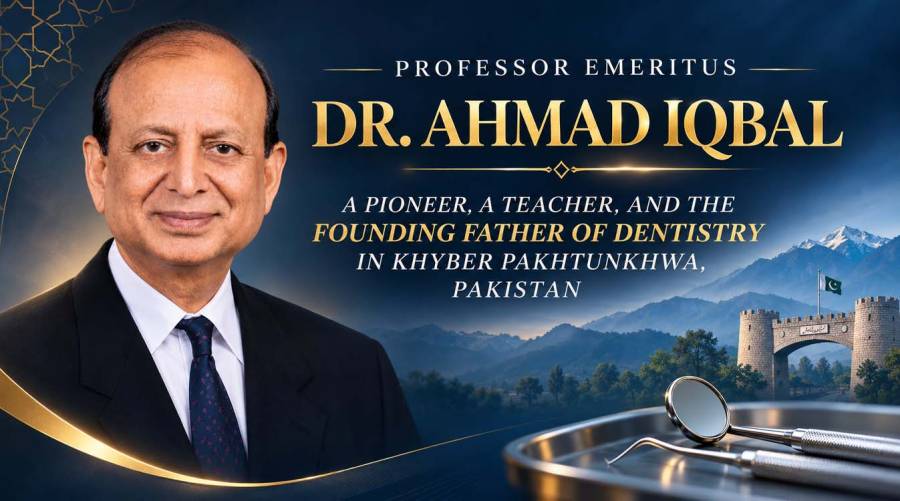
Professor Emeritus Dr. Ahmad Iqbal was one such teacher. His contribution to the establishment and development of dental education in Khyber Pakhtunkhwa represents a defining chapter in the history of our profession.
The beginnings of a pioneering vision
To appreciate the significance of Professor Ahmad Iqbal's contribution, we must return to the early 1960s, when formal dental education in the province was still in its infancy.
The proposal to establish a dental teaching department at Khyber Medical College was initiated by the late Dr. Hassan Raza Shah, then Principal of de’Montmorency College of Dentistry, Lahore. The initiative received encouragement from General Mohammad Akram, then Principal of Khyber Medical College, and Mr. Mohammad Ali, then Vice-Chancellor of the University of Peshawar. Within this pioneering initiative, Professor Ahmad Iqbal assumed the responsibility of establishing and leading the Department of Dentistry.
Prof. Ahmad Iqbal completed his doctorate at the University of Munich, Germany, in 1958 and subsequently served for five years at a university dental hospital in Germany. He returned to Pakistan in 1964 and chose to join Khyber Medical College, where he was assigned the task of establishing the Department of Dentistry. The institution that would eventually become Khyber College of Dentistry began its journey with remarkably modest resources: two rooms and an initial intake of just 14 students.
What followed was an undertaking that demanded far more than academic knowledge. In the absence of an established tradition of dental education in the province, academic systems had to be developed, clinical training organized, professional standards established, and the foundations of a new discipline laid.
Professor Ahmad Iqbal helped transform this modest beginning into a sustainable academic enterprise. His contribution was not simply to lead a department but to help create the conditions in which dental education could take root and flourish.
The graduation of the first batch in 1968 marked a significant milestone, while the recognition of the Bachelor of Dental Surgery programme further strengthened its academic standing. These developments opened a new professional pathway for young people in the province and contributed to the future provision of dental care for its population.
He did not inherit an established institution; he helped lay the foundations upon which one could be built. That is the defining achievement of a pioneer.
From two rooms to an institution of generations
The subsequent evolution of Khyber College of Dentistry reflects the enduring value of those early foundations. Over the decades, dental education expanded to encompass additional disciplines, clinical facilities, postgraduate training, research, and broader academic opportunities. The department attained the status of an independent college in 1990, marking another important chapter in its institutional development.
This progress was made possible through the collective efforts of successive generations of teachers, clinicians, administrators, and public servants. Nevertheless, the significance of the formative years cannot be overlooked. Every enduring institution depends upon the vision, commitment, and institutional groundwork of those who establish it.
Professor Ahmad Iqbal's contribution must therefore be understood within the wider history of dental education in the province. The academic initiative he helped establish became a centre for educating dental professionals, advancing clinical practice, and preparing future generations to serve society.
The story of Khyber College of Dentistry is not merely one of institutional expansion. It is a story of opportunities created, professional standards strengthened, and lives transformed through education. Its influence has extended beyond Peshawar, reaching communities throughout Khyber Pakhtunkhwa, across Pakistan, and beyond our national borders.
His contribution to the dental profession
Professor Ahmad Iqbal's contribution deserves recognition at several interconnected levels.
First, he helped establish a local pathway for professional dental education.
Second, he helped establish the institutional basis for undergraduate dental training.
Third, his work contributed to the development of dental services within the province.
Fourth, he helped create an academic platform for the future development of dental specialties.
Finally, he contributed to the development of a professional tradition that extended beyond his own lifetime.
The influence of an educational pioneer is not confined to the students whom he personally teaches. It continues through the graduates who educate others, the clinicians who mentor younger colleagues, the specialists who advance their disciplines, and the academic leaders who strengthen professional institutions.
This is perhaps the most enduring measure of his contribution.
A teacher's influence beyond the classroom
Institutions are often remembered for their achievements, but teachers are remembered through the people they inspire and the values they leave behind.
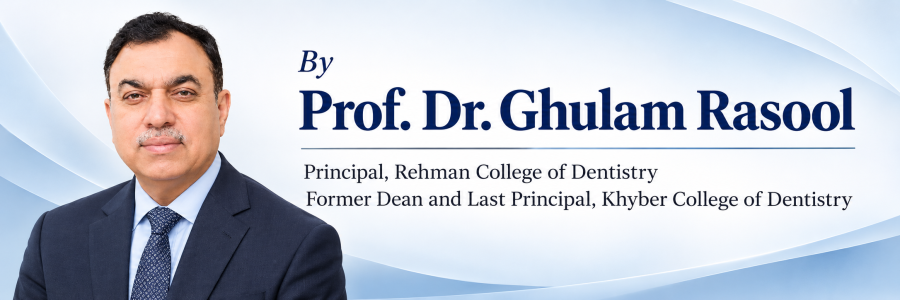
As one of Professor Ahmad Iqbal's former students, I have come to appreciate his significance with increasing clarity over the course of my professional life. As students, we tend to concentrate on acquiring knowledge, completing our training, and preparing for our careers. It is often only when we assume responsibilities of our own that we fully recognise the influence of those who helped shape our professional foundations.
A teacher's impact extends far beyond the lessons delivered in a classroom. It influences how we approach challenges, the standards we uphold, the decisions we make, and the responsibilities we accept towards those who place their trust in us.
These qualities are particularly important in dentistry, a profession that demands scientific understanding, sound clinical judgement, technical precision, ethical integrity, and compassion. Every patient deserves not only competent treatment but also dignity, respect, and understanding.
The educational foundation Professor Ahmad Iqbal helped establish provided generations of students with the opportunity to develop these professional attributes. Through their subsequent work in clinical practice, teaching, research, and public service, his influence has continued to reach far beyond the institution where his pioneering journey began.
The true legacy of a teacher is measured not only by what students learn, but also by what they carry forward and pass on to others.
A legacy of service to society
The establishment of dental education in Khyber Pakhtunkhwa also carried profound social significance. Oral health is integral to overall health and well-being, yet the availability of appropriate dental care depends substantially on trained professionals, effective educational institutions, and a sustained commitment to public health.
By helping establish the foundations of dental education within the province, Professor Ahmad Iqbal contributed to the development of a local professional workforce capable of responding to the needs of its own communities.
Every dentist trained, every patient treated, and every student mentored represents a continuation of that broader mission. Whether working in hospitals, private practices, academic institutions, or community health programmes, dental professionals contribute to relieving pain, preserving oral function, promoting prevention, and improving quality of life.
The full significance of Professor Ahmad Iqbal's work cannot be captured through appointments, administrative milestones, or institutional records alone. Its impact is reflected in the professional lives of successive generations and in the countless acts of patient care, teaching, and service made possible by the educational tradition he helped establish.
From student to institutional leadership
My association with Khyber College of Dentistry is deeply personal. It is the institution where I received my education, developed my professional aspirations, and began a journey that eventually led me to academic leadership.
Having served as its Dean and Principal, I came to appreciate more fully the responsibility of preserving an institution's heritage while preparing it for the demands of the future. Leadership requires us to safeguard what is valuable, improve what needs strengthening, and ensure that the institution remains relevant to the educational and healthcare needs of coming generations.
These responsibilities also deepen one's understanding of the pioneers who came before us. Their achievements must be considered in the context of the circumstances they faced, the resources available to them, and the challenges of establishing something that had not previously existed.
My own professional journey has reinforced my gratitude for those who created opportunities for others to learn, teach, and serve. Whatever contribution I have been able to make to dental education is part of a much larger collective endeavour—one that began with the vision and determination of pioneers such as Professor Ahmad Iqbal.
Remembering him, therefore, brings both the sadness of losing a revered teacher and the profound gratitude of having benefited from the educational legacy he helped create.
Our responsibility to carry the vision forward
Honouring a pioneer requires more than remembering the past. It requires us to accept responsibility for the future.
Today's students learn in laboratories, develop clinical skills in teaching hospitals, engage with research, and prepare for professional responsibilities within institutions shaped by earlier generations. The opportunities available to them are the result of decades of dedication, institutional development, and academic service.
They must recognise that professional success is not measured solely by qualifications, titles, financial achievement, or technical expertise. It is equally reflected in integrity, compassion, respect for scientific evidence, commitment to lifelong learning, and service to society.
As dental education continues to evolve, institutions must embrace innovation, strengthen research, improve clinical standards, and maintain the highest ethical principles. Above all, they must ensure that education remains centred on the development of competent, responsible, and compassionate professionals.
We honour our predecessors most meaningfully when we provide future generations with the quality of education, mentorship, and professional example that enables them to become not only better dentists but also better human beings.
The most fitting tribute to a pioneer is not simply to remember where the journey began, but to ensure that it continues with purpose.
Professor Ahmad Iqbal helped establish more than a department of dentistry; he helped open a pathway for generations of dental professionals in Khyber Pakhtunkhwa.
Buildings may change, academic programmes may evolve, and technology may transform the practice of dentistry. Yet the fundamental purpose of professional education remains constant: to advance knowledge, serve humanity, and prepare future generations for the responsibilities entrusted to them.
On behalf of those privileged to learn within the tradition he helped establish, and in my personal capacity as one of his former students, I offer my deepest respect and enduring gratitude.
May his legacy continue to inspire excellence in dental education, integrity in professional practice, compassion in patient care, and an unwavering commitment to the service of humanity.
From Dental News Pakistan
The legacy of great teachers lives on through the generations they inspire. As we remember the pioneers who shaped dentistry in Pakistan, we remain committed to preserving their stories and celebrating their contributions.
CLICK HERE TO FOLLOW Dental News Pakistan WhatsApp Channel for more tributes, professional insights, and stories that honour the past while inspiring the future of dentistry.