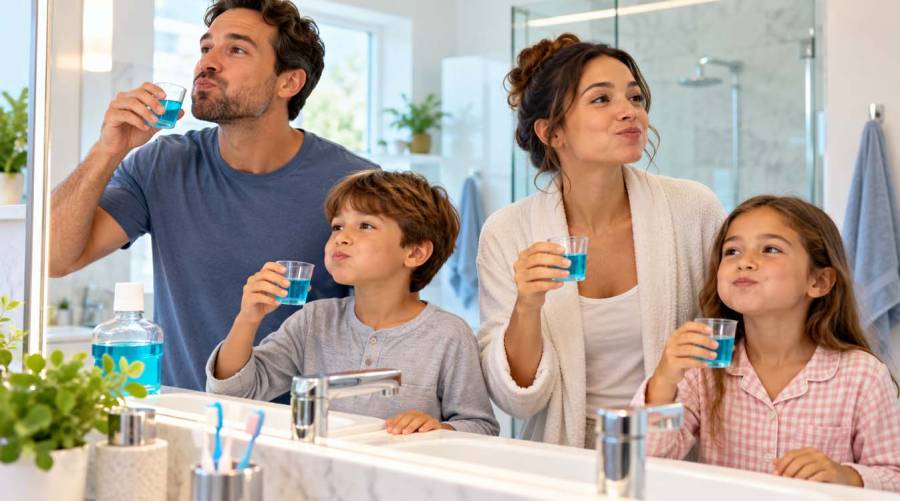
KARACHI: The mouthwash you use to soothe painful gums, fight plaque or protect your child's teeth may not always contain what its label promises. That concern has emerged from government laboratory tests in Karachi, where four oral-care products, including a children's mouthwash, have been declared spurious, adulterated and unregistered.
The findings are particularly troubling for two medicated mouthwashes. Both were found to contain no detectable benzydamine, an ingredient used to relieve pain and inflammation in the mouth, while another declared ingredient, the antiseptic chlorhexidine, was present at less than one-tenth of its stated strength.
The investigation also identified a mouthwash marketed for children and another promoted for plaque control. Although their individual ingredient results differ from those of the first two products, both failed the laboratory's overall assessment.
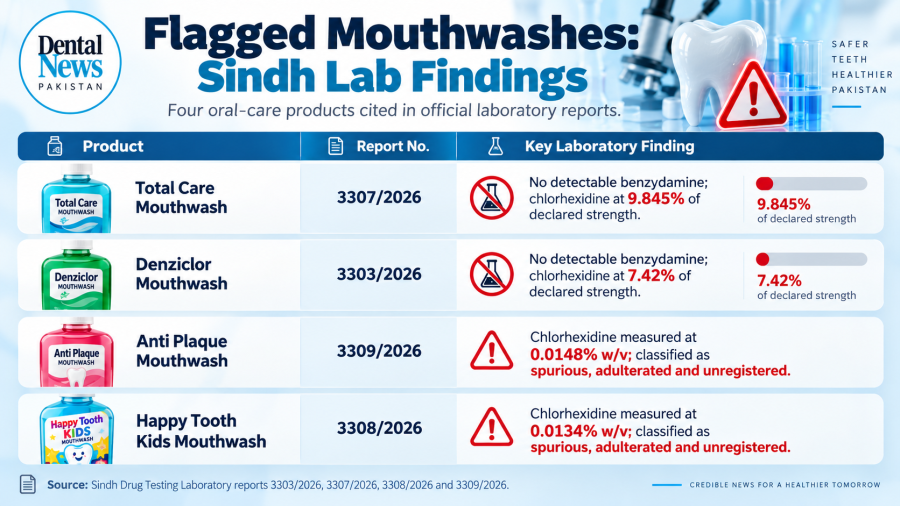
The four products identified are Total Care Mouthwash, Denziclor Mouthwash, Anti Plaque Mouthwash and Happy Tooth Kids Mouthwash.
An examination of the official Sindh Drug Testing Laboratory reports by Dental News Pakistan reveals another concerning detail: all four reports describe the tested samples as containing "filthy and putrid substances."
The documents also record missing batch numbers, manufacturing licence numbers and product registration numbers, raising further concerns about product identification, traceability and regulatory compliance.
The reports, dated October 28, 2026, were signed by Syed Adnan Rizvi, Provincial Government Analyst and Director of the Sindh Drug Testing Laboratory, Karachi.
The findings concern the samples examined. The laboratory documents do not establish that every bottle sold under the same product names is defective or how widely the questioned products may have been distributed.
Which four mouthwashes were flagged by the Sindh laboratory?
The official laboratory reports identify four products purportedly manufactured by M/s LC Care Pharma, Karachi.
The findings are as follows:
Total Care Mouthwash: The ingredient meant to relieve pain was missing
One of the clearest examples comes from Total Care Mouthwash, which declared two medicinal ingredients on its packaging: benzydamine hydrochloride 0.15% and chlorhexidine gluconate 0.2%.
Benzydamine is an anti-inflammatory medicine used in certain oral preparations to relieve painful or inflamed conditions affecting the gums, mouth and throat.
Chlorhexidine, meanwhile, is an antiseptic used in appropriate formulations to reduce oral bacteria and help manage plaque and gingivitis.
But the laboratory findings showed a striking difference between what the Total Care label declared and what the tested sample contained.
No benzydamine hydrochloride was detected.
The report recorded a concentration of 0.0000%, compared with the declared 0.15%.
Chlorhexidine was detected at just 0.01969%, against the declared concentration of 0.2%.
That represents only 9.845% of the stated strength, far below the laboratory report's specified acceptance range of 90–110%.
The sample was classified as spurious, adulterated, substandard and unregistered.
For someone experiencing painful or inflamed gums, the concern is straightforward. A medicated mouthwash may appear to offer relief, yet the questioned sample did not contain one declared ingredient at a detectable level and had substantially less of another.
Denziclor Mouthwash: Less than one-tenth of its declared antiseptic strength
The findings involving Denziclor Mouthwash followed an almost identical pattern.
The product also declared 0.15% benzydamine hydrochloride and 0.2% chlorhexidine gluconate.
Once again, laboratory testing found no detectable benzydamine.
Chlorhexidine was measured at only 0.0148%, equivalent to 7.42% of the stated concentration.
In other words, the submitted sample contained less than one-tenth of the antiseptic strength represented on the label.
The laboratory classified Denziclor as spurious, adulterated, substandard and unregistered.
These findings matter because patients may use medicated rinses as part of dental treatment or to help manage painful gums and other oral-health problems.
When a product's declared medicinal ingredients are absent or significantly below specification, there is no basis for assuming that the tested formulation will provide the same benefits as a correctly manufactured medicine.
The laboratory results do not prove that a particular patient's condition deteriorated because of the questioned product. They do, however, establish substantial deficiencies that warrant regulatory scrutiny and professional attention.
Why missing benzydamine, reduced chlorhexidine matter
The two substances play different roles in oral care, and their absence or reduced concentration should not be viewed as a minor technical problem.
Benzydamine is used to relieve pain and inflammation associated with conditions such as sore gums, mouth ulcers and oral discomfort following certain dental procedures.
A patient may use a mouthwash containing benzydamine expecting relief from these symptoms.
If laboratory testing cannot detect the ingredient, the patient cannot assume that the product is delivering the intended benzydamine effect.
Chlorhexidine is an antiseptic used in selected oral-care preparations to help control bacterial plaque and gingivitis. Dentists may recommend suitable chlorhexidine-containing products as part of a broader treatment plan.
According to the American Dental Association, therapeutic antimicrobial mouthrinses can help reduce plaque and gingivitis when used alongside toothbrushing and interdental cleaning.
However, mouthwash is not a replacement for routine oral hygiene or necessary professional treatment.
For a therapeutic product, ingredient strength is important. A formula containing a fraction of its declared active ingredient cannot automatically be regarded as equivalent to the stated formulation.
That is what makes the Total Care and Denziclor findings particularly significant.
Happy Tooth Kids Mouthwash: Why parents should pay attention
Among the four products, Happy Tooth Kids Mouthwash deserves special attention because it was marketed for children.
Parents choosing an oral-care product for a child may understandably be influenced by its presentation, flavour, claims about cleanliness and promises of better dental hygiene.
The product photographs accompanying the laboratory documentation show child-oriented packaging featuring cartoon-style tooth illustrations.
Yet the laboratory report raises concerns that cannot be resolved by its appearance.
Report No. 3308/2026 identified chlorhexidine gluconate at 0.0134% weight per volume and classified the submitted sample as spurious, adulterated and unregistered.
The report does not specify a declared concentration for comparison. Therefore, the measured chlorhexidine level alone does not establish that the product was understrength by a particular percentage.
However, the laboratory's overall classification and its recorded observations concerning the sample's condition and missing regulatory identifiers remain significant.
The question for parents is not simply whether a children's mouthwash tastes pleasant or looks appealing. It is whether the product is appropriately formulated, regulated and suitable for the child's age and needs.
The American Dental Association advises that children younger than six should generally not use mouthrinse unless directed by a dentist, partly because younger children may swallow significant quantities rather than spit them out.
That guidance applies broadly to mouthrinses and is not a finding that Happy Tooth Kids Mouthwash caused harm.
Nevertheless, the inclusion of a children's product in the investigation makes the need for reliable formulation and product-quality safeguards especially important.
Anti Plaque Mouthwash also fails laboratory assessment
The fourth product, Anti Plaque Mouthwash, was examined under laboratory report No. 3309/2026.
Its packaging promoted oral-hygiene benefits, including plaque control and cleaner teeth.
Laboratory analysis recorded chlorhexidine gluconate at 0.0148% weight per volume.
For dental patients, the finding highlights a distinction that is easy to overlook: the claims printed on a bottle are not independent proof that the formulation has met the necessary quality requirements.
A mouthwash marketed for plaque control must be evaluated on the basis of its actual composition, safety, quality and regulatory compliance, rather than advertising claims alone.
No batch numbers recorded: How can consumers check their bottles?
Another important concern emerges from the identification details recorded in the four reports.
Every one of the mouthwash reports lists the batch number as "Not Mentioned."
The documents also record manufacturing licence numbers and product registration numbers as not mentioned on the labels.
The samples carried manufacturing and expiry dates of December 2025 and December 2028, respectively.
The absence of batch information is particularly relevant when a product has been flagged for quality deficiencies.
Batch numbers allow manufacturers, regulators, pharmacies and distributors to trace products back to particular production runs.
They can also help determine the scope of a market investigation and identify potentially affected stock.
When usable batch details are unavailable, consumers may find it harder to establish whether a bottle corresponds to the questioned sample.
The reported dates and packaging information may offer some clues, but they do not provide reliable batch-level confirmation.
It is also important not to confuse missing regulatory information on the submitted labels with a final determination that the named company lacks all required licences.
The laboratory's classifications and the company's regulatory status must be considered through the appropriate official records and legal processes.
What should you do if you have one of these mouthwashes?
For consumers who own a bottle bearing one of the four identified names, the immediate priority should be checking its details rather than assuming that every product with the same name has been conclusively shown to be defective.
If you have Total Care Mouthwash, Denziclor Mouthwash, Anti Plaque Mouthwash or Happy Tooth Kids Mouthwash, seek verification from a qualified pharmacist, dentist or the relevant drug-control authority before further use.
Retain the bottle and its packaging, including any available manufacturer, batch, registration and expiry information.
For parents, particular caution is appropriate before giving children a mouthrinse whose regulatory status or quality is in doubt.
Patients experiencing persistent gum inflammation, mouth ulcers, unexpected irritation or other oral-health problems should seek a dental examination rather than relying solely on a mouthwash.
Dentists and pharmacists should review stock matching the identified product names and obtain clarification from the regulatory authorities where questionable products are found.
Suspected pharmaceutical quality defects can also be reported through the Drug Regulatory Authority of Pakistan's established reporting mechanisms.
Patients using a prescribed medicated rinse should consult their dentist or pharmacist about an appropriate verified alternative rather than abandoning necessary treatment without guidance.
A warning that goes beyond four mouthwashes
The four oral-care products were part of a wider Sindh laboratory investigation involving nine healthcare products, including eye and ear preparations and a skin lotion.
For the dental profession, however, the mouthwash findings deserve particular attention because they concern products associated with everyday oral hygiene, gum health and children's dental care.
The laboratory reports establish that two tested mouthwashes contained no detectable benzydamine and substantially less chlorhexidine than declared.
Two additional products, including a children's rinse, were also classified as spurious, adulterated and unregistered.
All four reports recorded serious concerns regarding the condition of the samples and missing regulatory identification details.
The extent of commercial distribution and any resulting patient harm remain unconfirmed in the supplied documents.
Yet the investigation raises an important issue of public trust.
Patients cannot determine whether a medicated mouthwash contains the correct ingredients simply by looking at its colour, smelling its flavour or reading its promises.
And parents should not have to rely on attractive packaging alone when choosing products intended for their children's oral health.
Before you rinse, check your mouthwash. What is inside the bottle matters far more than what is promised on the label.
Stay informed with Dental News Pakistan
CLICK HERE TO FOLLOW Dental News Pakistan on WhatsApp for important oral-health findings should not be overlooked. Stay informed about dental product safety, regulatory developments, clinical research and news affecting patients and dental professionals.