LAHORE: Artificial intelligence can generate multiple-choice questions within seconds. But producing an examination question that genuinely measures a dental student's knowledge, understanding and clinical judgement is a different challenge altogether.
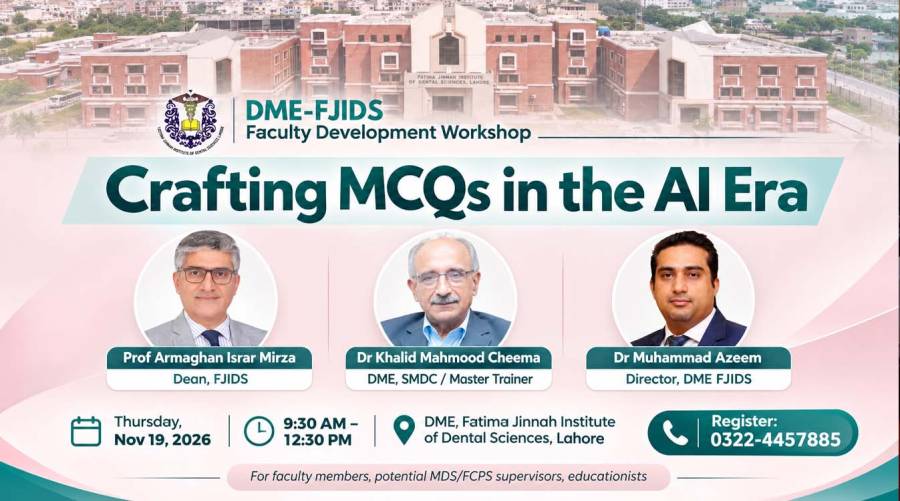
That distinction will take centre stage at the Fatima Jinnah Institute of Dental Sciences (FJIDS), Lahore, which is organising a faculty development workshop titled "Crafting MCQs in the AI Era" on Thursday, November 19, 2026.
Scheduled from 9:30am to 12:30pm at the institute's Department of Medical Education (DME), the three-hour session will bring a practical focus to one of the most consequential responsibilities of dental educators: designing assessments that test learning fairly, accurately and meaningfully.
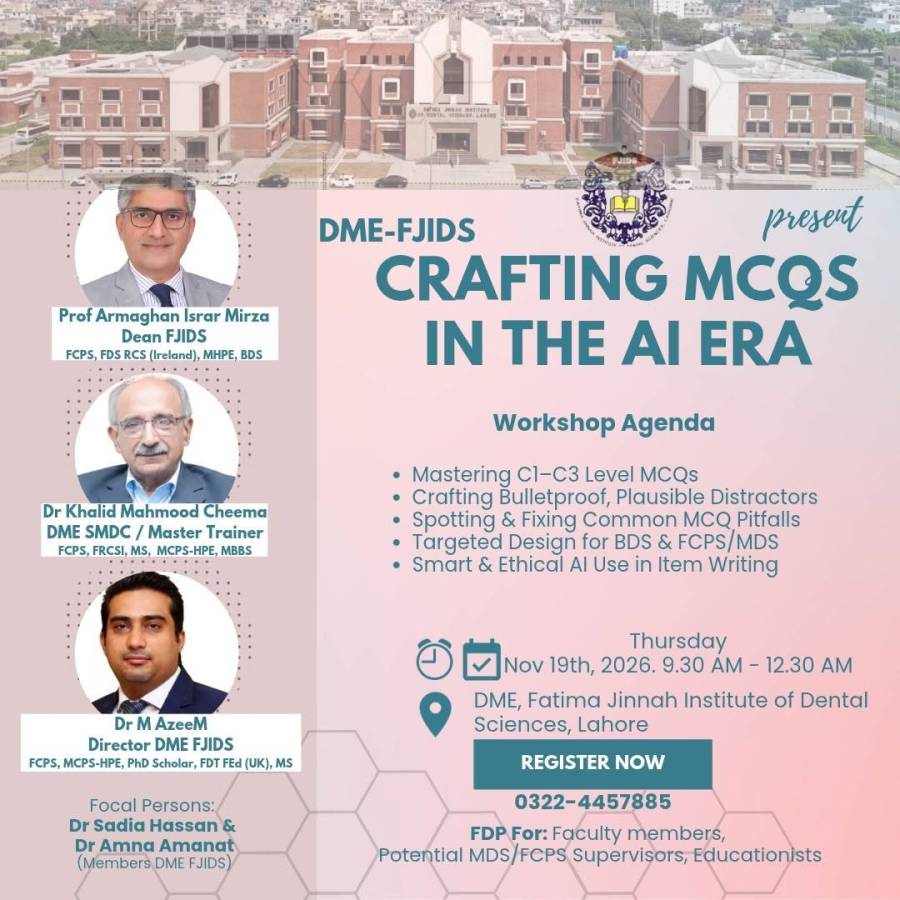
The programme will address multiple-choice question (MCQ) construction across C1–C3 cognitive levels, the development of plausible distractors, common weaknesses in question writing, assessment design for BDS and FCPS/MDS training, and the smart and ethical use of artificial intelligence.
The workshop is intended for faculty members, prospective MDS and FCPS supervisors, and educationists involved in teaching, training and assessment.
Beyond memorisation: What makes an MCQ worth asking?
A well-written MCQ does considerably more than distinguish a correct answer from an incorrect one.
In dental education, assessment questions can help determine whether a student has merely memorised information or can recognise a clinical problem, interpret findings and make an appropriate decision.
Yet writing such questions is not always straightforward. Ambiguous wording, poorly constructed answer options, unintended clues and questions that reward guessing rather than understanding can undermine the quality of an examination.
FJIDS has placed these concerns at the heart of its forthcoming faculty development programme.
The workshop's first major area of focus, mastering C1–C3 level MCQs, will address the cognitive demands of assessment, including the progression from factual recall and understanding towards applying knowledge.
This distinction matters for dental students preparing for professional examinations and for postgraduate trainees whose assessments increasingly involve clinical reasoning and decision-making.
Another central topic will be the construction of bulletproof, plausible distractors — the incorrect answer options that make an MCQ intellectually meaningful rather than easily predictable.
Effective distractors should be credible enough to challenge a learner who has not fully mastered the subject, without misleading someone who understands the underlying clinical principles.
The workshop will also address how educators can recognise and correct common MCQ pitfalls, including weaknesses that may compromise clarity, fairness or the validity of the assessment.
These principles are consistent with established medical education guidance, including recommendations from the American College of Surgeons, which emphasise clear question stems, plausible alternatives, alignment with learning objectives and the avoidance of unintended answer clues.
The AI question: Faster preparation, but who ensures accuracy?
The most contemporary dimension of the workshop concerns artificial intelligence and its expanding role in educational content development.
Generative AI offers educators the ability to draft examination questions, explore alternative clinical scenarios and generate possible answer options with considerably less initial writing effort.
However, an AI-generated question can appear convincing while containing clinical inaccuracies, ambiguous wording, an incorrect answer key or answer choices that do not properly assess the intended competency.
For dental examinations, where questions may influence academic progression and professional training, these shortcomings deserve particular attention.
An important issue is therefore not simply whether AI can produce MCQs, but how educators can evaluate, refine and validate AI-assisted questions before they reach an examination paper.
The FJIDS workshop explicitly includes smart and ethical AI use in item writing, placing modern technology alongside established assessment principles rather than treating automation as a replacement for academic expertise.
This approach reflects a wider international discussion. UNESCO's guidance on generative AI in education and research advocates human oversight, ethical validation and the responsible integration of AI into teaching and assessment.
For dental educators, the underlying principle is particularly relevant: technology may assist the preparation of assessment material, but responsibility for clinical accuracy, educational relevance and fairness remains with qualified professionals.
Senior dental, medical education faculty featured in the programme
The workshop features three senior academics with backgrounds in dental education, clinical training and assessment.
Prof Dr Armaghan Israr Mirza, Dean of the Fatima Jinnah Institute of Dental Sciences, Lahore, is named in the programme.
Dr Khalid Mahmood Cheema, associated with the Department of Medical Education at Shalamar Medical & Dental College (SMDC), Lahore, is also featured. Dr Cheema has a background in medical education and surgical training, with qualifications including MBBS, FCPS, FRCSI, MS and MCPS-HPE.
The third academic is Dr Muhammad Azeem, Director of the Department of Medical Education at FJIDS, whose work includes dental education, postgraduate training and academic development.
Dr Muhammad Azeem has been involved in several FJIDS educational initiatives, including faculty development activities and postgraduate academic programmes.
Furthermore, Dr Sadia Hassan and Dr Amna Amanat, both named as members of DME FJIDS, are the programme's focal persons.
Dr Amna Amanat is additionally an Assistant Professor in the Department of Oral Biology at FJIDS.
Why this workshop matters for BDS and FCPS/MDS supervisors
Assessment design is not merely an administrative exercise. It influences what students prioritise, how they prepare for examinations and the competencies they are expected to demonstrate.
For undergraduate BDS teachers, the challenge lies in creating questions appropriate to each stage of learning while maintaining academic rigour and relevance to the curriculum.
For potential FCPS and MDS supervisors, the task can be more demanding, particularly when questions are expected to assess clinical reasoning and the application of specialised knowledge.
The workshop's focus on targeted MCQ design for undergraduate and postgraduate dental education is therefore timely.
It also highlights a practical opportunity for institutions to review how examination questions are prepared, scrutinised and improved — especially as AI-assisted writing tools become more accessible.
The challenge for educators is not to produce the greatest number of questions in the shortest possible time. It is to ensure that every question serves a defensible educational purpose.
Workshop date, venue and registration details
The faculty development workshop "Crafting MCQs in the AI Era" is scheduled as follows:
- Date: Thursday, November 19, 2026
- Time: 9:30am–12:30pm
- Venue: Department of Medical Education, Fatima Jinnah Institute of Dental Sciences, Lahore
- Intended participants: Faculty members, potential MDS/FCPS supervisors and educationists
- Focal persons: Dr Sadia Hassan and Dr Amna Amanat, DME FJIDS
- Registration and enquiries: 0322-4457885
Interested participants can contact the organisers using the registration number provided in the official workshop announcement.
As AI continues to enter academic workflows, the ability to distinguish a quickly generated question from a carefully validated assessment item may become an increasingly valuable skill for dental educators.
The FJIDS workshop offers an opportunity to examine that distinction and strengthen the fundamentals of assessment design.
Stay connected with Dental News Pakistan
CLICK HERE TO FOLLOW Dental News Pakistan on WhatsApp for timely updates on faculty development workshops, postgraduate education, research, professional opportunities and the developments shaping dentistry across Pakistan and beyond.