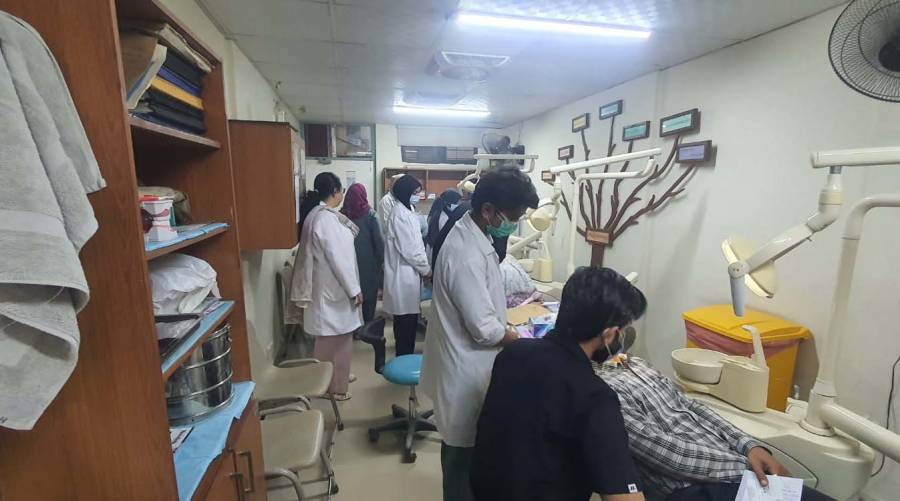
KARACHI: For a dental student, examining a real patient for the first time marks an important transition from learning disease in textbooks to understanding the person sitting in the dental chair.
That transition was at the centre of a hands-on Oral Diagnosis activity organised by the Department of Community Dentistry, Hamdard University and Dental Hospital, for second-year Bachelor of Dental Surgery (BDS) students.
The initiative gave students their first meaningful opportunity to interact directly with patients and practise essential diagnostic, ethical and professional skills under the supervision of experienced faculty members and House Officers.
But the exercise was designed to teach more than how to look inside a patient's mouth.
Students were expected to understand that a proper clinical examination begins before the intraoral assessment — with consent, communication, history-taking, confidentiality and respect.
Every student examined a patient under supervision
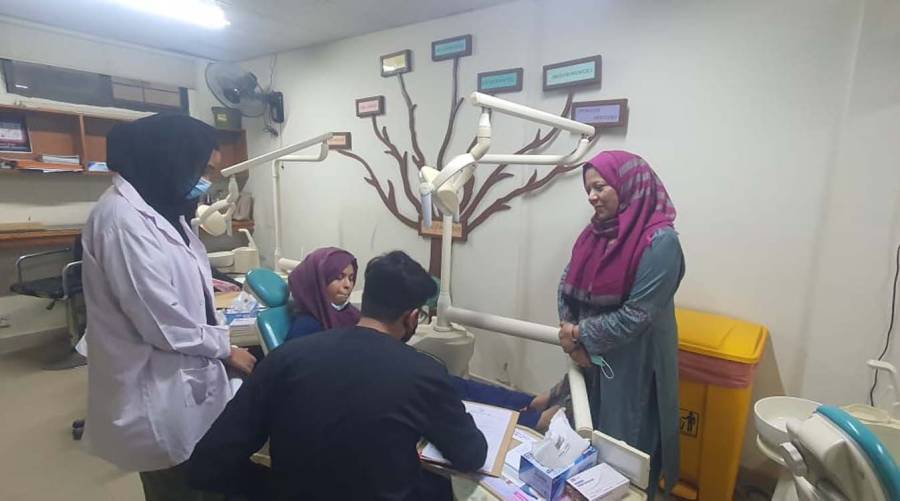
During the activity, each second-year BDS student was given an opportunity to examine a patient under supervision.
The training introduced students to the fundamental sequence of patient assessment, including obtaining informed consent, recording a comprehensive patient history, maintaining confidentiality and conducting an intraoral examination.
For students at an early stage of their clinical education, the experience provided an opportunity to connect theoretical concepts with their practical application in a real healthcare setting.
History-taking, for example, is not simply an administrative exercise. It can influence how a clinician interprets symptoms, identifies relevant medical or dental factors and approaches subsequent examination.
Similarly, informed consent and confidentiality were presented not as formalities but as essential components of professional dental care.
Dr. Shikoh Naz puts ethics alongside diagnosis
Dr. Shikoh Naz, Associate Professor, Department of Community Dentistry, played a key role in supervising, guiding and mentoring students throughout the activity.
His teaching placed particular emphasis on respectful patient communication, professional behaviour, ethical conduct, informed consent and the protection of patient confidentiality during every stage of the clinical examination.
Students were encouraged to approach patients with dignity, compassion and respect while maintaining appropriate professional boundaries.
That emphasis is particularly significant at the beginning of clinical training.
Technical knowledge may help a student recognise oral disease, but the quality of patient care also depends on whether the patient understands what is happening, feels respected and can trust that personal health information will remain confidential.
By introducing these principles alongside examination skills, the department sought to build professional habits before students move into more complex clinical responsibilities.
Infection control was treated as part of patient care
The Oral Diagnosis activity was also conducted with close attention to infection-prevention and sterilisation protocols.
Students were taught the importance of maintaining a safe and hygienic environment for both patients and healthcare providers while following appropriate infection-control procedures during examination.
Cleanliness and sterilisation therefore formed part of the learning experience rather than being treated as a separate operational responsibility.
For future dentists, infection prevention is central to everyday clinical practice because examination and treatment routinely involve close contact with the oral cavity, instruments and potentially contaminated surfaces.
The activity reinforced that patient safety depends not only on diagnostic ability but also on consistent adherence to clinical hygiene and infection-control standards.
College leadership monitors clinical standards
The department said Hamdard University and Dental Hospital maintains a broader institutional focus on cleanliness, hygiene and infection control across its clinical departments.
Professor Dr. Syed Imran, Principal, regularly visits different departments to monitor cleanliness, hygiene and overall clinical standards.
He is joined in this oversight by Dr. Saima Asim, Vice Principal, reinforcing the institution's emphasis on maintaining a safe, clean and professionally managed healthcare environment.
Their involvement adds an institutional layer to the principles introduced during the students' practical activity.
For learners, this means infection control and professional standards are not confined to a single workshop or examination requirement but are expected to remain part of routine clinical practice.
Why the first patient encounter matters
One of the most important aspects of the activity was its timing.
These were second-year BDS students, still developing the foundation on which later clinical practice will be built.
By introducing supervised patient interaction at this stage, the department gave students an opportunity to learn how clinical knowledge, communication, ethics and patient safety come together in practice.
A student may remember how to perform an intraoral examination, but the broader clinical lesson is more demanding: how to introduce oneself, obtain consent, listen carefully, ask appropriate questions, maintain confidentiality, observe infection-control requirements and make the patient feel respected throughout the encounter.
Those behaviours can become increasingly important as students progress towards independent clinical decision-making.
Building clinicians before independent practice begins
The activity ultimately brought together five essential elements of dental training: clinical learning, patient-centred care, ethical practice, confidentiality and infection prevention.
For Hamdard University's second-year BDS students, the exercise represented more than an introduction to Oral Diagnosis.
It was an early lesson in what professional dental care is expected to look like.
The technical component taught students how to begin assessing a patient.
The ethical component taught them how that assessment should be conducted.
And the infection-control component reinforced the responsibility of protecting both the patient and the clinical team.
By combining all three under direct supervision, the Department of Community Dentistry sought to give students a stronger foundation before they assume greater clinical responsibilities later in their BDS training.
For young dental students, that may be the most important outcome of the exercise: learning early that diagnosis is not only about identifying disease — it is also about how the patient is treated while that diagnosis is being made.
Stay connected with Dental News Pakistan
CLICK HERE TO FOLLOW the official Dental News Pakistan WhatsApp Channel to stay connected with the issues shaping your education and career. Follow the Dental News Pakistan WhatsApp Channel for dental education updates, research news and student opportunities.