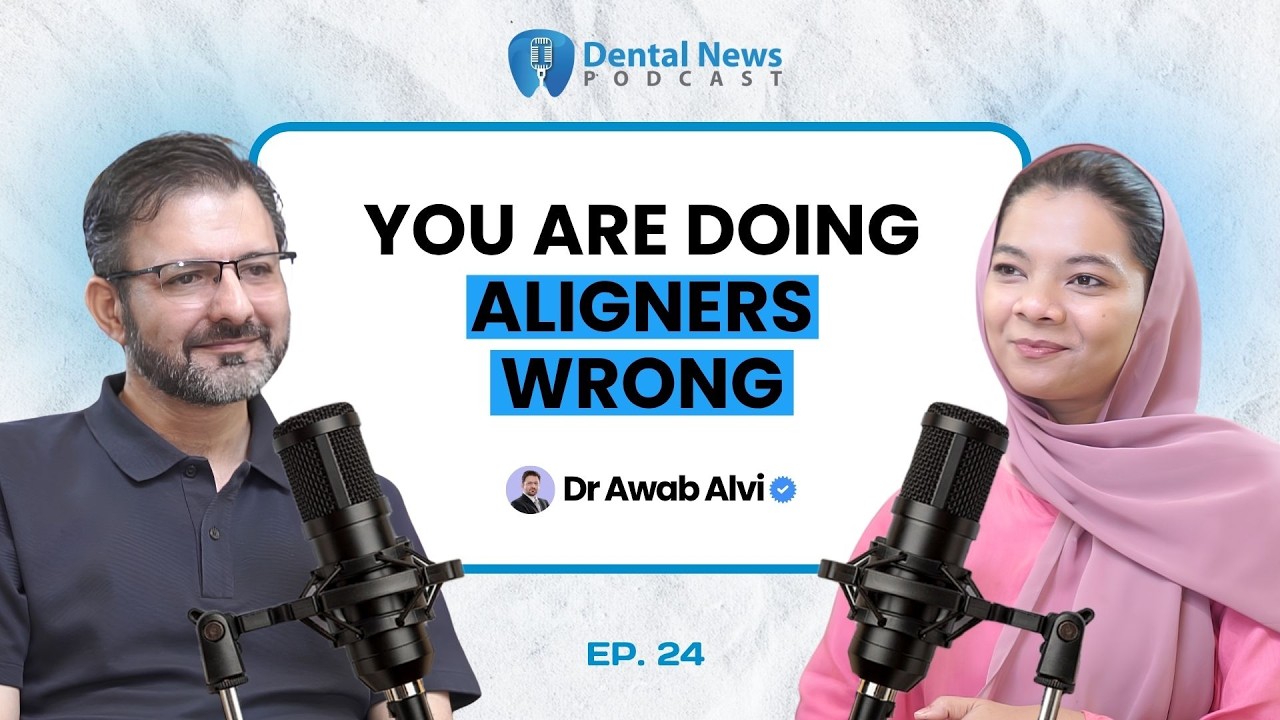
KARACHI: Dr Awab Alvi, a prominent fourth-generation dentist, orthodontist and owner of Alvi Dental and Inspire Dental, is preparing to launch a hands-on digital dentistry training facility in Karachi, with the new centre potentially becoming operational within the next two to three months.
Dr Awab, who has undertaken postgraduate and advanced dental training at institutions including St. Louis University and the University of Pennsylvania, has built much of his clinical and educational work around orthodontics, magnification-assisted dentistry, clear aligners and emerging digital technologies. He returned to Pakistan after his overseas training and continued a family dental legacy spanning four generations.
Speaking in an extensive interview on the Dental News Podcast, Dr Awab revealed that the upper floor of Alvi Dental’s original Sindhi Muslim practice is being converted into a large auditorium and physical training space.
The planned centre is expected to support practical education in areas increasingly reshaping modern clinical dentistry, including clear aligner therapy, intraoral scanning, digital prosthodontics, 3D printing and technology-assisted workflows.
The development is significant because Dr Awab believes dentistry is moving faster than conventional educational structures — and that simply attending lectures or acquiring another certificate will not adequately prepare young dentists for what clinical practice may look like five or 10 years from now.
Awab Alvi shifts from online to hands-on dental training after COVID-era fatigue
The proposed centre also represents a deliberate change in the way Dr Awab wants to teach.
He said his experience conducting an extensive online aligner training programme made him question whether sophisticated clinical subjects can be taught effectively through virtual sessions alone.
Dr Awab described online education as having become increasingly “stale” after the COVID era, saying physical interaction allows participants to ask questions as problems emerge, observe techniques more closely and engage with instructors in ways that are difficult to replicate through a screen.
He now intends to move toward face-to-face, hands-on dental education, particularly for training that requires a deeper understanding of biomechanics and digital workflows.
Asked during the podcast when the initiative could begin, Dr Awab estimated a timeframe of approximately two to three months.
He said substantial preparation had already taken place and that the upper floor of the Sindhi Muslim practice was being transformed into a large auditorium. He also indicated that he and his colleague Dr Najeeb intend to involve skilled professionals capable of providing advanced practical instruction.
That could allow Pakistani dentists to access some forms of advanced training locally rather than automatically looking overseas for certification or preparation courses.
Dr Awab specifically noted that dentists often travel abroad for specialised examinations or certification programmes, while at least some of that preparation could potentially be delivered in Pakistan if the right expertise and facilities are available.
Clear aligners could become one of the centre’s major teaching areas
One of the strongest themes emerging from Dr Awab’s discussion was the need for deeper education in clear aligner therapy.
While Pakistan produces highly trained orthodontists in conventional fixed-appliance treatment, Dr Awab believes knowledge of traditional biomechanics does not automatically translate into mastery of clear aligners.
He argues that clinicians need to understand the behaviour of the plastic itself, the positioning and design of attachments, the direction of force, and what he describes as the different push-and-pull mechanics required to achieve particular tooth movements.
During a previous online programme involving around 300 participants, Dr Awab said he felt only a small number demonstrated a particularly deep understanding of what aligners could actually do and how their biomechanics worked.
His criticism is not directed at the quality of traditional orthodontic training.
On the contrary, Dr Awab described Pakistan’s conventionally trained orthodontists as highly competent in wire bending and fixed-appliance biomechanics. His concern is that aligner mechanics constitute an additional area that requires its own structured education.
That distinction could shape the training model at the planned Karachi centre.
Rather than teaching dentists merely how to approve a computer-generated aligner plan, Dr Awab wants clinicians to understand why a particular movement should occur, where force is being applied, which attachment is required and why a treatment may fail to track as predicted.
Training expected to move beyond orthodontics
The proposed facility is not intended to become only an aligner teaching centre.
Dr Awab said his practice already uses technologies including 3D printing, digital scanning and computer-assisted prosthodontic workflows, creating opportunities for a broader digital dentistry curriculum.
One practical example discussed in the podcast was the use of an intraoral scanner to assess crown preparations.
Digitising and magnifying a preparation can make small deficiencies easier to identify, allowing a dentist or trainee to examine margins, reduction and preparation geometry on a much larger scale.
According to Dr Awab, technologies such as scanning should therefore be understood not merely as replacements for conventional impressions, but also as clinical learning and quality-control tools.
That philosophy runs through much of his approach to technology: the value of a device lies not in owning it or promoting it on social media, but in whether it helps produce better dentistry.
Dr Awab challenges dentistry’s certificate culture
Another important element of the proposed education model is likely to be its focus on skills rather than titles.
During the podcast, Dr Awab questioned the professional tendency to measure continuing education by the certificate received at the end of a programme.
He argued that whether something is called a fellowship, certificate course or master's programme matters far less than what the dentist can actually do differently for a patient afterwards.
In his view, qualifications can easily become little more than something displayed “on the wall” if the underlying training does not translate into improved clinical work.
Dr Awab believes clinical excellence, continued self-development and patient outcomes should remain the primary objectives of professional education.
That could make the new facility particularly relevant to BDS graduates, house officers, young practitioners and postgraduate trainees searching for practical exposure rather than another credential alone.
Digital dentistry is changing what dentists need to know
For Dr Awab, the training centre is part of a much larger transformation taking place across dentistry.
His own family history provides an unusual perspective on that evolution.
He has described earlier generations practising during an era when dental equipment was mechanically driven, followed by the introduction of modern handpieces and, eventually, the arrival of microscopes, digital records, CAD/CAM, intraoral scanners, 3D printing and artificial intelligence.
Dr Awab believes dentistry is already well into this digital transition and that clinicians entering the profession today may eventually work very differently from the generation that trained them.
He predicts that in the years ahead, dentists could increasingly become “healers rather than treaters,” with technology carrying out more of dentistry’s repetitive mechanical tasks while human clinicians retain responsibility for diagnosis, planning, judgment and patient care.
He has even suggested that, over a longer horizon, robotic systems could potentially carry out procedures such as crown preparation according to digitally prescribed parameters.
That remains a prediction rather than an available clinical technology, but it illustrates why Dr Awab believes dental education must begin preparing clinicians for workflows that may not yet be routine.
A broader push to prepare Pakistan’s dentists for the next decade
Dr Awab’s plans for the Karachi training facility ultimately fit into a broader argument he makes about the future of the profession.
He believes young dentists should not assume that what they learned in dental school will remain sufficient throughout their careers.
Dental colleges necessarily teach within established curricula, while technology can move far more quickly.
Clinicians, he argues, therefore need to look five or 10 years ahead and deliberately build skills that may become essential in the next generation of practice.
WATCH DR AWAB ALVI'S FULL PODCAST HERE
Stay connected with Dental News Pakistan
CLICK HERE TO FOLLOW the official Dental News Pakistan WhatsApp Channel for the latest PMDC updates, dental education news, student achievements, professional developments, research breakthroughs and important regulatory developments affecting Pakistan's dental community.