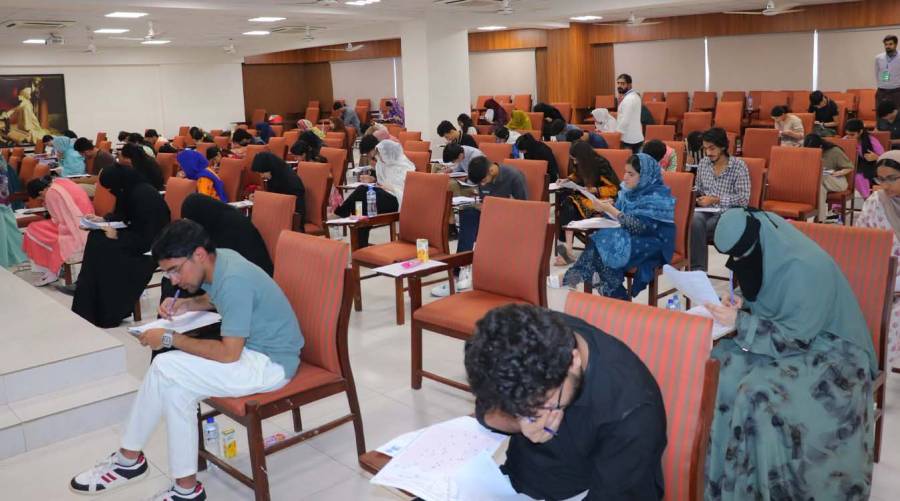
LAHORE/PESHAWAR/ISLAMABAD: MDCAT 2026 results have begun coming in across Pakistan, with Punjab and Khyber Pakhtunkhwa releasing their results while candidates in the federal-region group, Sindh and Balochistan await final updates from their respective conducting authorities.
The University of Health Sciences (UHS), Lahore, announced the Punjab MDCAT 2026 result on September 24, four days after the examination was held across the province on September 20.
According to the official UHS result notification, 49,202 candidates were registered, of whom 47,475 appeared and 1,727 remained absent.
A total of 37,708 candidates secured the minimum 55% marks required for MBBS eligibility, giving Punjab an MBBS qualifying rate of 79.43%. For BDS, where the minimum qualifying threshold is 50%, 40,457 candidates qualified, representing 85.22% of those who appeared.
The result, however, also shows how candidates were distributed across the higher score bands — figures that may be more relevant as the focus shifts from merely qualifying MDCAT to competing for admission on merit.
14,714 Punjab candidates score 150 or above
According to UHS, 1,772 candidates, or 3.73%, scored between 170 and 180 marks, placing them in the highest score bracket reported by the university.
Another 6,682 candidates scored between 160 and 169, taking the number obtaining 160 marks or above to 8,454, or about 17.8% of all candidates who appeared.
A further 6,260 candidates scored between 150 and 159, meaning 14,714 candidates — nearly 31% of those who sat the test — obtained 150 marks or higher.
The remainder of the UHS score distribution showed 5,357 candidates scoring 140-149, 4,939 scoring 130-139, 4,382 scoring 120-129, 4,188 scoring 110-119, and 3,766 scoring 100-109.
Another 3,111 candidates scored between 90 and 99, while 7,018 candidates, or 14.78%, obtained 89 marks or below.
The figures underline an important distinction for applicants: meeting the MDCAT qualifying threshold does not guarantee admission to an MBBS or BDS programme. Candidates who qualify must still compete under the prescribed admission criteria, aggregate calculation, merit position, applicable quotas and availability of seats.
KP announces 66% MDCAT success rate
Khyber Medical University (KMU), Peshawar, has also announced the MDCAT 2026 result for Khyber Pakhtunkhwa.
According to the results 38,845 candidates applied for the examination and 37,747 appeared, with KMU reporting an overall success rate of 66%.
Muhammad Hassan secured first position after obtaining a perfect 180 out of 180 marks. Shariq Noor stood second with 179 marks, while Muhammad Mujeeb also obtained 179 marks and was reported in third position.
The KMU result showed that 1,926 candidates scored between 170 and 180 marks.
Under the applicable eligibility criteria, candidates securing at least 55% in MDCAT can apply for MBBS, while a minimum of 50% is required for BDS. Admission, however, remains subject to the relevant merit and eligibility rules and availability of seats.
The reported 66% KP success rate should not be treated as directly equivalent to Punjab's 79.43% MBBS qualifying rate without clarification of the exact denominator and qualifying category used by KMU. For that reason, the two percentages are better reported separately rather than presented as a direct provincial performance comparison.
SZABMU was the conducting university for ICT, AJK, GB and Riyadh
For candidates from Islamabad Capital Territory, Azad Jammu and Kashmir and Gilgit-Baltistan, the examination was administered by Shaheed Zulfiqar Ali Bhutto Medical University (SZABMU), Islamabad, which was designated as the conducting university for these jurisdictions. SZABMU also handled the international MDCAT centre in Riyadh, Saudi Arabia.
PM&C figures showed 1,245 candidates registered from Islamabad, 2,761 from AJK and 1,721 from Gilgit-Baltistan. Nationally, PMDC reported 138,158 registered candidates for MDCAT 2026 across Pakistan and the Riyadh centre.
SZABMU subsequently received queries and concerns from candidates regarding its MDCAT answer keys. In an official notice, the university said the concerns had been reviewed across all four question-paper codes — Code 1, Code 2, Code 3 and Code 4 — and necessary corrections had been incorporated.
The university said the updated MDCAT 2026 result would be announced on Friday, September 25 and advised candidates to follow its official communication channels.
At the time of this report on September 25, SZABMU's official results listing had not yet displayed a separate final MDCAT 2026 result notification, while its website continued to carry the notice stating that the updated result would be released during the day.
Candidates from ICT, AJK, GB and the Riyadh centre should therefore rely on the final result issued by SZABMU rather than calculating their position solely from earlier versions of the answer keys.
Sindh MDCAT result still awaited
In Sindh, MDCAT 2026 was conducted by SIBA Testing Services (STS), Sukkur IBA University.
According to PMDC figures, 34,233 candidates were registered from Sindh, making it the country's third-largest MDCAT candidate group after Punjab and Khyber Pakhtunkhwa.
STS established examination arrangements across Sindh, including centres in Karachi, Hyderabad, Jamshoro, Mirpurkhas, Larkana, Shaheed Benazirabad and Sukkur, as well as an Islamabad centre for the relevant candidate group.
The testing service released the MDCAT answer keys after the examination. However, as of the latest check on September 25, an official final Sindh MDCAT 2026 result had not been verified through the STS/Sukkur IBA official channels reviewed for this report.
Candidates should therefore distinguish between an answer key, which allows an estimated score to be calculated, and the officially declared result, which remains the authoritative record for admission purposes.
Balochistan result also awaited
In Balochistan, the MDCAT was conducted by Bolan University of Medical and Health Sciences (BUMHS), Quetta, for candidates allocated to the province.
PM&DC reported 9,923 registered candidates from Balochistan for MDCAT 2026.
The examination was conducted at centres in Quetta and Islamabad, with the Islamabad arrangement catering to Balochistan-domiciled candidates appearing outside the province.
BUMHS released answer-key-related information following the September 20 examination, but Dental News Pakistan could not verify an official final MDCAT 2026 result notification from BUMHS as of the latest check on September 25.
Until an official result is published, candidates should rely on communications issued directly by BUMHS and PMDC rather than unofficial result websites or social-media claims.
More than 138,000 candidates registered nationwide
MDCAT 2026 was conducted on September 20 under the national regulatory framework of the Pakistan Medical and Dental Council (PMDC), while designated universities and testing institutions administered the examination for their respective jurisdictions.
PMDC said 138,158 candidates were registered nationwide and for the Riyadh international centre. The provincial and regional breakdown included 49,199 candidates from Punjab, 38,841 from Khyber Pakhtunkhwa, 34,233 from Sindh, 9,923 from Balochistan, 2,761 from AJK, 1,721 from Gilgit-Baltistan and 1,245 from Islamabad.
There are small differences between some of PMDC's pre-examination registration figures and the final numbers subsequently reported by individual conducting universities. For example, UHS's final result notification lists 49,202 registered candidates in Punjab, while PMDC had earlier reported 49,199. Similarly, KMU's result reporting gives 38,845 applicants, compared with the earlier PMDC figure of 38,841. For result reporting, the final figures issued by the respective conducting universities are the more relevant numbers for their jurisdictions.
Qualification is only the first stage of the admission race
For candidates, the release of MDCAT results marks the beginning rather than the end of the admission process.
The minimum MDCAT requirement is 55% for MBBS and 50% for BDS, meaning that on the 180-mark test, a candidate requires at least 99 marks for MBBS eligibility and 90 marks for BDS eligibility.
But those thresholds establish only the minimum eligibility to apply.
Actual admission to a medical or dental college will depend on the candidate's admission aggregate, merit position, eligibility under the applicable admission regulations, quota where relevant, and the number of available MBBS or BDS seats.
That is why Punjab's result provides a more significant picture beyond its 79.43% qualification rate: although 37,708 candidates crossed the MBBS threshold, only 14,714 scored 150 or above and 8,454 reached 160 or above.
With Punjab and KP results now announced, attention is turning to SZABMU's updated result for ICT, AJK, GB and Riyadh, and the pending official results from Sindh and Balochistan, which will complete the national MDCAT 2026 result picture.
Stay connected with Dental News Pakistan
CLICK HERE TO FOLLOW the official Dental News Pakistan WhatsApp Channel for the latest PMDC decisions, BDS policy developments, dental education news, student updates, professional developments and regulatory changes affecting Pakistan’s dental community.